Showing posts with label hornby railroad. Show all posts

Tuesday, 17 September 2013

Review of the Hornby R3120X LNER J83 00 Gauge DCC Fitted Steam Locomotive

The R3120X is a Railroad model. It bears stating up front, just so you realise that the price tag will probably reflect the build quality. Usually, Railroad also means D-ring couplings moulded onto a Lima style chassis.

In this case, I was mislead slightly by the Amazon description, which indicates that it has NEM pockets. If this is the case, then they've hidden them well.

I'd err on the side of caution and say that, from the picture below, these are moulded Lima style D-ring couplers, rather than NEM couplings as listed. (If anyone knows differently, please let me know in the comments section!)
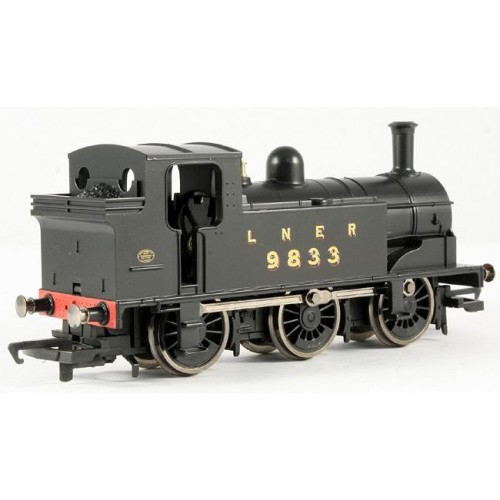
(Thanks to Papamallard for the picture)

Still, it is a handsome J83, at a reasonable price.If you can get it for the 40 - 50 GBP range, including delivery, that is. So, what makes it such a good deal?

For a start, it has DCC fitted. This is a little odd, since as a Railroad model, with D-ring couplings, it is going to most likely find itself on an analogue layout (I would think) rather than a DCC one. And, curiously, that's it's value - it's a great price for a DCC fitted model.

So, where does it fit in on your layout?

Briefly, the J83's were made at the turn of the last century, and lived on through the grouping changes into BR ownership proper. The last J83 was removed from service in the early 1960s.

They were generally used for shunting and short haul of goods. In fact, they were used for mineral trip workings and goods transfer up until 1909. Hornby also sell, in their Railroad range, a pack of three 12T mineral wagons, which would be a good place to start, if creating a layout around this loco.
There's also a book by Peter Tatlow, which I've not been able to find new, but which is available second hand, and which covers all the various wagon types that might have been seen behind the J83.

Bachmann do some interesting wagons, such as fish vans, in LNER livery, in the correct era, which would have made sense in and around the Scottish coast. Fitting them would require a change in coupling, of course.

Bachmann also do a 45 ton Bogie Well Wagon, in LNER livery, with a boiler, which could feasibly have been seen being shunted around by a J83 at this time.

Another option is to look at the shed history, post 1930, of these locos. Into the 1930s, they were allocated to sheds (for shunting duties) from which they would, generally, retire.

LNER 9833 was allocated to shed 65A, Eastfield, near Glasgow. Eastfield itself has had a turbulent history, having been destroyed by fire in 1919, used to service up to 200 steam locos after the rebuild, was subsequently closed in 1966, only to re-open in 2004 as a TMD.

If we place 9833 at  Eastfield following the fire and rebuild, then a few options come to mind, including shunting around locos that have come in for repair, or for shunting things like the aforementioned LNER bogie plus boiler.

Hopefully that sparks a few likely scenarios, and provides food for thought for what is a well priced, small loco with an interesting history.

(Thanks to LNER.info, and RailUK, among others, for the information.)

Wednesday, 28 August 2013

What Coupling System Do Hornby Currently Use?

This is a question that has come up a few times now, and there is a really quick answer : they use two, Lima-style D-ring couplings that are moulded onto the rolling stock (loco, wagon, carriage, etc.) and NEM pocket couplings with reasonably standard tension lock couplings inserted.

The Hornby Railroad (cheaper) range have the D-ring couplings, and the Hornby non-Railroad ranges have the NEM couplings. If in doubt, simply use the product code to search the Hornby shop. If the product has NEM couplings, it will say so under 'Special Features'.

However, there are a few points that I suspect lurk behind the original question. The first related to compatibility.

The old Lima style D-rings are moulded onto the rolling stock, so that they are part of the chassis. This means that changing them to NEM couplings, whilst doable, is a messy process.

You'd be better off buying the more expensive, and slightly more attractive (neither are actually prototypical) models with NEM couplings if that's your goal. Of course, there's a caveat.

That caveat is that Hornby actually sell packs of NEM compatible D-ring couplings. These enable you to buy up Railroad (cheaper) wagons and carriages and then couple them to Hornby non-Railroad locomotives, by taking out the tension lock couplings and replacing them with the D-ring ones.

That's part of the beauty of NEM couplings - you can change the actual couplings for others. This becomes necessary, even if you've splashed out on non-Railroad stock, if you use Brian Kirby style magnetic uncoupling.

The reason is that the Hornby tension lock couplings are made of ferrous material, unlike the Bachmann ones (for example) which are not. If you have ferrous tension lock couplings, then the Brian Kirby approach doesn't work, as the magnets affect the coupling directly.

But that's the beauty of the NEM couplings - if you really don't like them, you can always swap them for some Kadee knuckle couplings, which are generally thought of as being more prototypical, and provide excellent delayed action magnetic uncoupling/coupling which is very versatile.

So, that's pretty much everything I now about the current coupling system that Hornby uses in both the high-end and Railroad product ranges.

Friday, 12 October 2012

Getting Started in Model Rail : High Street Brands

Everyone has to start somewhere in the model rail hobby, and one of the best ways is to buy some ready to run, off the shelf kit from one of the main high street brands.

There are many, many manufacturers of model rail equipment, locomotives and rolling stock, and they range from fairly specialist makes to two or three brands generally available on any high street, or via the web.

So, gauge by gauge, here is a guide to some of the most popular readily available brands for those just getting started with model rail.

OO - Hornby Railroad

Hornby International is one of the oldest established brands, with sub brands including Hornby, Hornby Railroad, and Lima.

Railroad is a hobby oriented brand, offering slightly cheaper, less detailed and lower specification locomotives and rolling stock. 

Since the acquisition of Scalextric, some of the Railroad locomotives allegedly come with a Scalextric motor, leading them to be less smooth to operate, and with unrealistic acceleration and top speeds.

Despite this, it's a good starting point for a model rail enthusiast; but be aware that the couplers are not generally compatible with other brands such as Bachmann and more expensive Hornby models.

Railroad boxes are easy to spot, as they have yellow flashing on the bottom, below the window.

OO - Hornby

Within the Hornby range, there are also various levels of finishing and price. While any model from this range will be of good quality, some are better value than others.

Where Hornby does stand out is with the excellent selection of starter packs, which are available from many toy shops. Often these are laid out next to makes like Mehano, and Lima, which can make Hornby (and Bachmann) seem a bit expensive, but the additional investment is well worth it.

OO/HO - Bachmann

Like Hornby, Bachmann has a number of sub-brands in the group, some of which produce European outline stock in HO, US also in HO, and British outline in OO.

Personally, from the various models I have purchased, Bachmann locomotives seem to be better finished, and smoother than the Hornby equivalents, but that some of the Hornby rolling stock (brake vans, for example) offer better value.

Bachmann rolling stock also all comes with standard NEM pockets, making it easy to extend the collection with more rolling stock. It is organized by era to make it easier to cross-match rolling stock without needing to overload on research!

HO - Piko

For European outline stock, Piko is probably the most accessible, and is available in Expert and Hobby, mainly French and German stock, organized by era and region. This makes it easy to match up stock and keep a consistent rake together.

Piko also make good value packs of both freight and passenger trains, complete with track, controllers, and layout ideas.

Piko Hobby boxes can be spotted by the red flashing with Hobby written on them. Piko Expert boxes have blue flashing with Expert written on.

N - Graham Farish

While the smaller gauges (N and Z) are less popular, they require less space, and are gaining in popularity.

Graham Farish, a Bachmann sub brand, provide excellent quality models, at very reasonable prices.

Z - Marklin

Marklin is a bit of an odd-ball, having chosen to implement a 3 rail power system for its locomotives, rendering it incompatible with all the others mentioned here.

For all that, in Z gauge, it does have some interesting starter packs, and is a very space-conscious way to get into model rail as a hobby.

Finally, a few notes about track. Peco is perhaps the largest manufacturer of track, but Hornby also manufactures its own. Generally, it is not possible to mix track between manufacturers, so if a Hornby pack is bought, future expansions will also need Hornby track.

However, HO and OO will both run on the same set-track (i.e. pre-cut, slot together pieces) regardless of manufacturer.

Power is supplied to the track via a special adapter, as either DC or AC. 16v AC is used for so-called DCC (digital command control) trains, while DC is used for analogue sets.

If in doubt - start with a DC (i.e. analogue) solution, as DCC can always be added at a later date. It's far harder to start with DCC as it comes with a whole slew of options, settings, and possibilities that baffle even experienced model rail enthusiasts!